
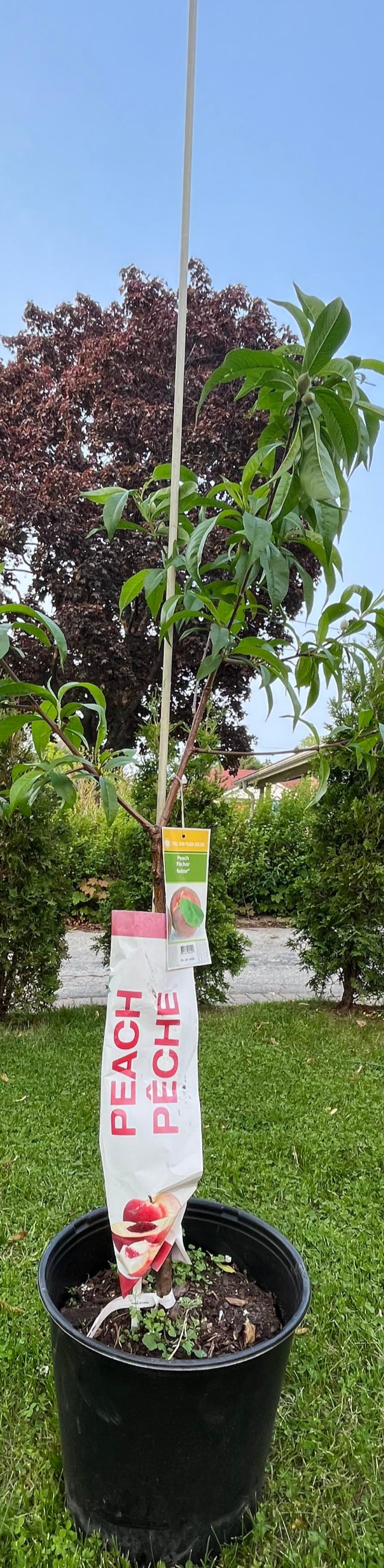

How-to choose the right peach tree?
Choose a type of peach tree that grows well in your climate. Peach tree’s grow best in climates with hot and humid summers that go into winter temperatures colder than 45 degrees F. Most peach tree varieties require a time in cold temperatures to grow effectively. This dormancy period is known as a peach tree’s “chill hour requirement.”
Look up the number of chilling hours typical of your climate to make sure it meets the requirements for your desired peach variety. Before you seal, double check the tag to make sure the gardening zone matches yours. Equally important, if you are only planting one peach tree like Tom and I, make sure it’s self-pollinating!
Planting in early spring is ideal as it gives the tree an entire growing season to rebound and recover from the shock of being transplanted. So spring plantings give the tree time to adjust to its new home before winter.
Location…location…location. Where to plant your peach tree
You can’t just plant a peach tree anywhere. It could die on you if it doesn’t like the spot you chose. So first and foremost, peach trees want full-sun. Select a spot that gets 8 hours of sun daily. Just as important is choosing a site that is shielded from the wind. Nothing worse than wind blowing all the beautiful pink and white blossoms off…and hence….your future fruit!
Shoot for a site that has well-drained sandy soil with a pH between 6.0 and 7.0. If your soil has poor drainage or is clay in nature like ours, you might have to amend it a bit because it requires fertile soil. Finally layout is vital. It’s pretty hard to move a tree once planted so it’s a good idea to make sure the location is perfect, especially if you have multiple plantings.
With trees, always look ahead to possible future problems such as overhead power lines, fences and walkways. And don’t plant too close to your neighbors property! Never on the properly line or near their pool.
Step-by-step peach tree planting instructions & our secret soil formula for success!
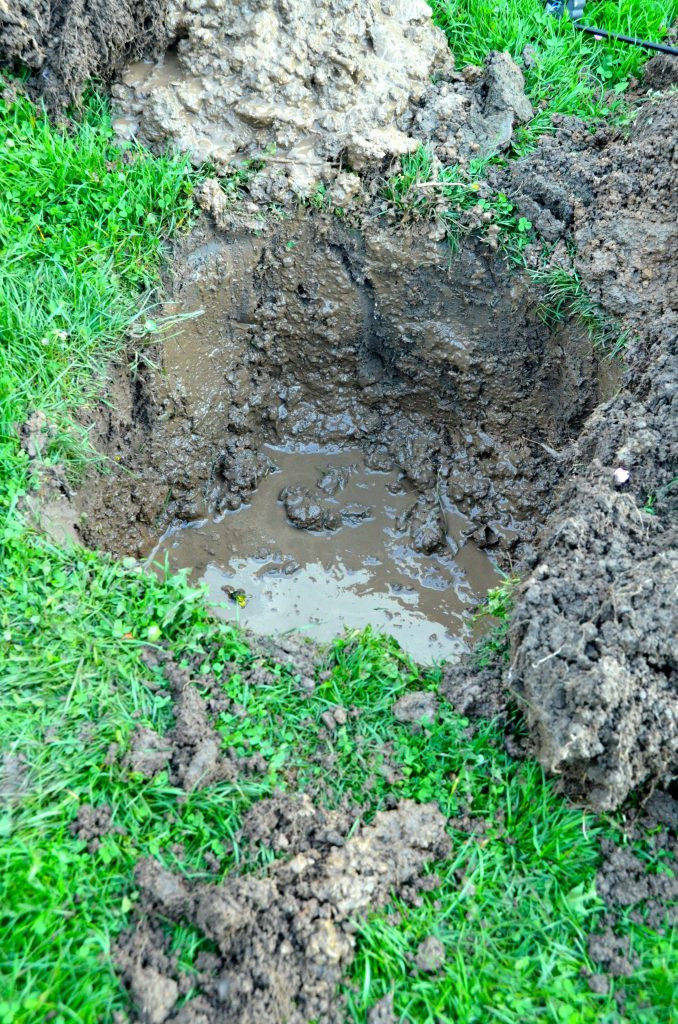
1.) Dig a planting hole a few inches deeper and twice as wide as the tree’s root ball.
If you are adding our suggested amendments to the bottom of the hole then you might have to add as much as 8 inches in depth to accommodate the extra bulk.If you do not need to amend your soil do not dig the hole any deeper than 2/3 of the root ball.
2.) Our soil is clay. Peach trees don’t like clay soil which is why we had to amend the soil. So we dug our hole extra deep and took out some of the existing topsoil to make room for our mixture of amended soil.
The topsoil removed from the hole can be used in low spots around your yard as a wonderful filler! It’s still excellent topsoil~ just not what the peach tree wants surrounding its most immediate and vulnerable roots.
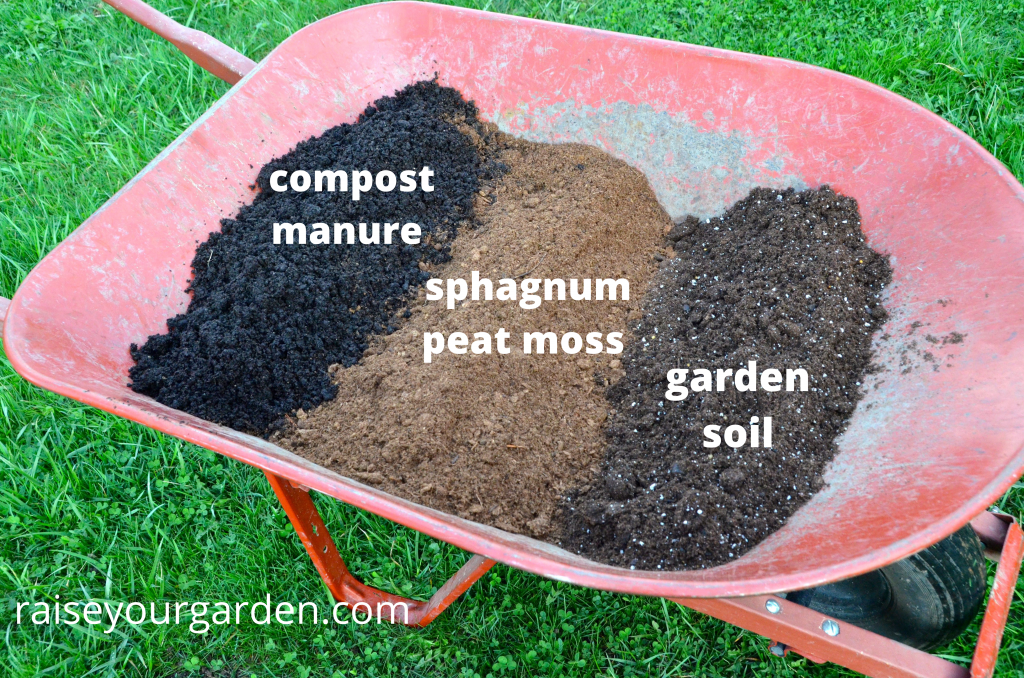
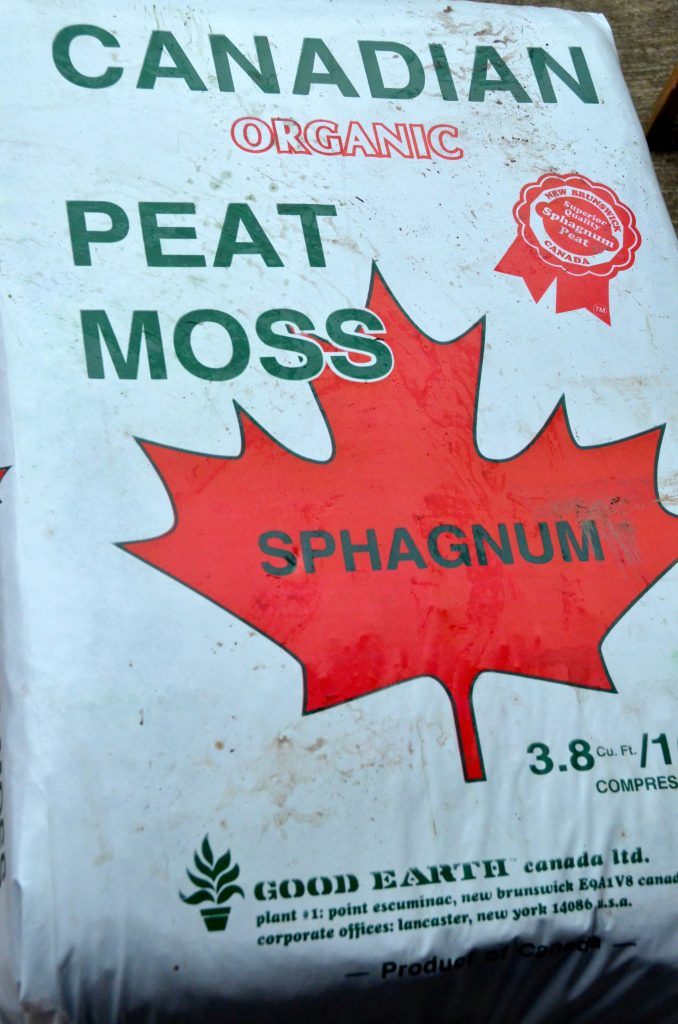
3.) In a big bucket or wheelbarrow mix our secret ingredients together for peach tree planting success. Combine Canadian sphagnum peat moss, composted manure and garden soil in equal parts.
This mixture is ideal to nourish the tree’s roots while lightening up the existing heavy soil. The Canadian sphagnum peat moss is the best if you can get your hands on some!
Just be aware the sphagnum peat moss has a low pH, so it may affect pH around the roots remembering the idea pH is between 6.0-7.0.
4.) With your hands, mix the ingredients well and create a mound at the bottom of the planting hole.
The bottom of the hole is where the amended soil will do the most good~ right near the roots! Pack this amended soil down tight so the root ball will be planted on firm soil. No gaps.

5.) Untangle and spread the tree’s roots out over the soil mound when you place the tree into the hole.
Use a hose or a bucket to water the tree before you backfill the hole but wait until it drains before completely backfilling with the amended soil from the wheelbarrow.
Plant the tree so the root ball is up to 1/3 above ground level and make sure your tree is vertical. At no time should the top surface of a root ball be below ground level. This will drown the plant and kill it quickly!
6.) Continue to backfill your hole with your amended soil up and around those roots. If you run out, go ahead and use some of the existing soil to backfill.
7.) Spread about 2 inches of organic mulch around the top. Mulch helps seal in moisture, discourages weeds, and enriches the soil. Mulch can also prevent water-pooling and freeze injury around the trunk going-into winter.
In the fall, add another 2-3 inches of mulch or a layer of straw for extra winter protection. Just try to keep the mulch 2-3 inches away from the stem base.
Insider tip: To encourage root growth away from the ball, loosen soil with a shovel several feet around the planting hole.
Watering your peach tree
Water is the most critical part of maintaining your new peach tree’s health. New plantings require more water than established ones. Water your tree right away when it’s delivered to your house or picked up, and twice a day until planted.
For the first year, you’ll have to water your peach tree regularly and deeply, especially during those dry summer months of July and August. In fact, larger shrubs and trees should be watered every 2-3 days for the entire season even if it rains.
Apply the water directly over the plant’s root system until a puddle forms around the base of the plant. This will ensure thorough watering. You may have to repeat this step 3 to 4 times each time you water.Roots on a newly planted tree or shrub don’t reach the surrounding soil until 4-6 weeks after planting.
If you are fretting over whether or not your peach tree is getting the water it requires, use a hand shovel and dig down alongside the root ball.
Peach tree pruning advice
This part is painful but must be done to increase fruit production once the tree matures. You must cut and prune the side branches and trim the top of the tree, I’d estimate about 30% off the top and sides.
Peaches bear fruit on second-year wood, so proper pruning this year affects your crop yield next year. Prune trees in the early summer during the tree’s first, second, and third years of life. After the third year, always prune in late April. Maintain the tree’s lovely shape by cutting shoots growing from the center of the tree.
Staking your tree
When staking your peach tree, place the stake tightly against the side of the root ball. Slightly angle the stake away from the tree. Drive the stake 6-8 inches into the undisturbed soil at the bottom of the root ball. Never into the root ball! Staking is important to keep younger trees growing vertically.
Fantastic fertilizing
Use a Bio-tone or a starter fertilizer equivalent at the time of planting, then a granular fertilizer such as 10-10-10 (1) month after planting. Choose a fertilizer high in phosphorus and low in nitrogen for best results.
https://raiseyourgarden.com/home/how-to-plant-a-peach-tree-to-make-it-thrive
How-to plant a peach tree to make it thrive - Raise Your Garden
It is easy to plant a peach tree if you select a location with full sun, fertile soil and sheltered from wind.
raiseyourgarden.com
'Info from web' 카테고리의 다른 글
| As a Seeker of Ficus Benjamina Cultivars (1) | 2025.08.27 |
|---|---|
| Cutting from Thuja Occidentalis Brandon Ceder (0) | 2025.05.24 |
| G-Shock Repair, Water-Proof, deep-cleaning, Screen-Protector (0) | 2025.05.16 |
| Swimming Pool ideas / 수영장 (0) | 2025.05.14 |
| African Violet info (0) | 2024.05.12 |


comments